

The Race for the United Nations: Bachelet Under Fire, Grossi in the Ascendant — and a War That Changes Everything.
Ruy Campos Dugone
3/25/20264 min read
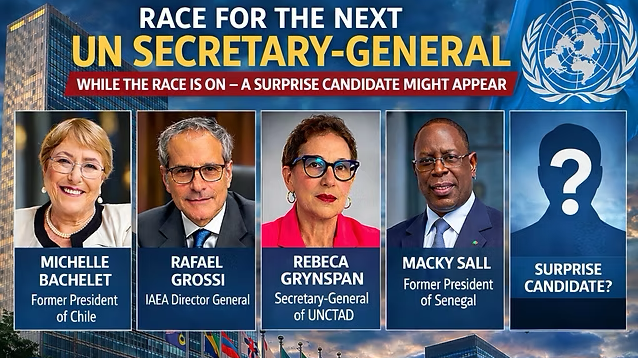
The week opened with a diplomatic rupture centred on Santiago, Chile, though its consequences extend well beyond the Andes — reaching, in due course, to the thirty-eighth floor of the Secretariat building in New York.
What Happened
Chile's Ministry of Foreign Affairs confirmed that the government of José Antonio Kast has withdrawn its support for former President Michelle Bachelet's candidacy for the post of Secretary-General of the United Nations, declaring the candidacy "unviable" on account of the fragmentation of Latin American nominations and what it described as differences with key actors in the selection process. The candidacy had originally been advanced during the Boric administration in coordination with Brazil and Mexico. Santiago made clear that, should Bachelet choose to continue independently, Chile would abstain from endorsing any other candidate in the process.
The diplomatic response was immediate. Eleven former foreign ministers and deputy ministers of foreign affairs issued a public letter expressing firm support for Bachelet and characterising the Kast government's decision as an "international embarrassment". Signatories include senior figures of Chilean diplomacy — among them José Miguel Insulza, Heraldo Muñoz, and Alberto van Klaveren. The former chancellors argued that Bachelet's candidacy reflects "the principles, objectives and permanent interests of Chile's foreign policy, with a sense of statehood", and posed a pointed question to the administration: how to justify withdrawing support from a distinguished compatriot, with credible prospects, backed by the two largest countries in the region?
Bachelet has confirmed she intends to remain in the race, sustained by the backing of Brazil and Mexico. She has not, as yet, made any public statement regarding Santiago's decision.
Why Bachelet Remains a Serious Candidate
Her credentials within the multilateral system are, to put it plainly, exceptional. Bachelet served two terms as President of Chile (2006–2010 and 2014–2018), subsequently leading UN Women and serving as United Nations High Commissioner for Human Rights between 2018 and 2022. That combination — head of state experience and senior United Nations leadership — is rare among regional candidates, and it is what distinguishes her from the field. The former chancellors also invoked the informal convention of geographic rotation within the organisation, noting that the only occasion on which Latin America has led the United Nations was thirty-five years ago, under Peru's Javier Pérez de Cuéllar. That precedent carries genuine weight in the diplomatic calculus of member states.
The Kast Decision: A Strategic Assessment
Examined dispassionately, the case has two sides. In favour of Santiago's position: the fragmentation of Latin American candidacies is not a fabrication — Bachelet, Rafael Grossi of Argentina, and Rebeca Grynspan of Costa Rica effectively compete for the same regional bloc, dividing votes and diminishing the prospects of each. A government is entitled to make a clear-eyed assessment of viability and act accordingly.
Against it: the timing and manner of the withdrawal produce a reputational cost that appears disproportionate to any strategic gain. Opposition deputy Raúl Soto described it as an unprecedented international embarrassment. Withdrawing formal support from a former head of state of one's own country, in the final weeks before nominations close, backed by the two regional giants, communicates institutional incoherence — and that is the signal received in foreign capitals, regardless of the reasoning offered in the communiqué.
The ideological dimension cannot be set aside, though it would be imprecise to reduce the matter entirely to it. Kast and Bachelet represent opposite ends of Chile's political spectrum, and it would be naïve to suggest that this played no role. What is clear, however, is that conflating partisan calculation with matters of state-level foreign policy carries a long-term cost. Chile's credibility as a multilateral actor does not reset when the next government takes office.
One point, however, must be stated directly: Kast's decision does not diminish Bachelet as a candidate. Her standing in international institutions, her experience and her networks are her own — they are not contingent upon Santiago's endorsement. What the decision does alter is the terrain she must now navigate. She will need to build, through bilateral engagement and political capital, the support that normally accrues to a formally sponsored candidacy. That work is now, and it is urgent.
The Full Field: Candidates to Succeed Guterres
António Guterres' mandate concludes on 31 December 2026, with the formal nomination window closing on 1 April and the selection of candidates anticipated by late July. The Latin American field is, by historical standards, unusually crowded.
Rafael Grossi, Argentina's representative, has directed the International Atomic Energy Agency since 2019 and carries the formal endorsement of the Milei government. He has articulated a vision of the Secretary-General as an actor who is "impartial but neither impotent nor indifferent", with an operationally focused approach to conflict resolution. Rebeca Grynspan, former Vice-President of Costa Rica and a long-standing figure within the UN development system, completes the Latin American trio. Beyond the region, the field is expected to include candidates from Eastern Europe, consistent with the convention of geographic rotation.
The Most Consequential Argument: Grossi, Iran, and the Nuclear Question
There is a dimension to this race that has, in recent days, shifted from background consideration to urgent foreground. The world stands at the threshold of a potentially significant armed confrontation involving Israel, the United States and Iran — one whose central axis is precisely the question of nuclear capability: whether Iran is to be permitted to achieve, or approach, the status of a nuclear power. That is the strategic core of the present conflict.
The individual who has spent six years managing the international inspection regime in Iran, who has personally negotiated access to contested installations, who understands the technical limits of verification and the political boundaries within which the IAEA must operate, is Rafael Grossi. In this context, his candidacy acquires a relevance that transcends regional rotation or diplomatic convention. The world may shortly require, at the helm of its principal multilateral institution, someone whose understanding of nuclear non-proliferation is not theoretical but lived — someone who has been in the room, who has read the reports, who knows precisely what is and is not verifiable. Grossi does not need to make that argument. He is already living it.
A Concluding Assessment
The episode between Kast and Bachelet is, at its core, a case study in what happens when ideology and statecraft are not kept sufficiently distinct. Each party has a defensible position. Kast is not wrong that a divided regional candidacy arrives weakened. Bachelet is not wrong that a figure of her standing deserved institutional loyalty rather than abandonment. What neither can fully control is the context in which this contest is now unfolding.
The race to succeed Guterres is no longer simply a matter of regional turns and diplomatic courtesies. It is taking place against a backdrop of potential armed conflict, nuclear risk, and institutional strain that the United Nations itself is struggling to manage. The question of who leads that organisation from January 2027 has rarely, in recent decades, felt more consequential.


WHERE TO FIND US:
Business Address: PO Box 12155, LONDON, WC1V 6DP, United Kingdom
Switchboard: +44 (0) 330 818 7382
Email: joinus@green-cross.org.uk


Endorsement of:


Disclaimer: The content on this website is for informational purposes only and does not constitute professional advice. For specific guidance, please contact us., and see Terms of Use.
Member of Green Cross International | Founded by Mikhail Gorbachev in 1993
Pro-cooperation · Pro-collaboration · Non-rivalry
© 2026 Green Cross United Kingdom. All rights reserved.