

Our Intelligence Imperative
Intelligence Layer
Intelligence for a World in Overshoot
Green Cross UK operates at the vital intersection of science, technology, economics, and human dignity.
Our intelligence platform distils the world’s most advanced research and pioneering initiatives into actionable knowledge. This serves as a definitive compass for our organisation, our partners, and our programmes—but its ultimate purpose is to deliver measurable impact for people and the planet.
Why Intelligence Matters
As an NGO, our most valuable asset is not capital — it is clarity. In a world saturated with sustainability claims, greenwashing and incomplete data, the ability to distinguish genuine impact from sophisticated narrative is itself a form of power.
The Intelligence Layer is how Green Cross UK earns and exercises that power. It is the system by which we synthesise the world's best science and thinking across disciplines, translating it into decisions, programmes and partnerships that create verifiable positive impact.
This page documents both the diagnosis — why the current economic model is ecologically insolvent — and the frameworks we draw on to move beyond it.


From Knowledge to Action:
The Ecological Ponzi Scheme
The Pyramid Scheme: The Risk of False Accounting
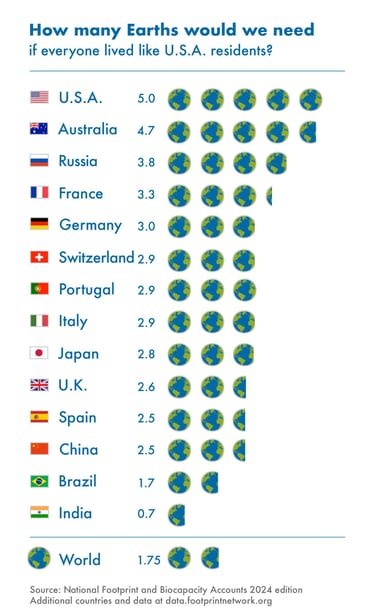
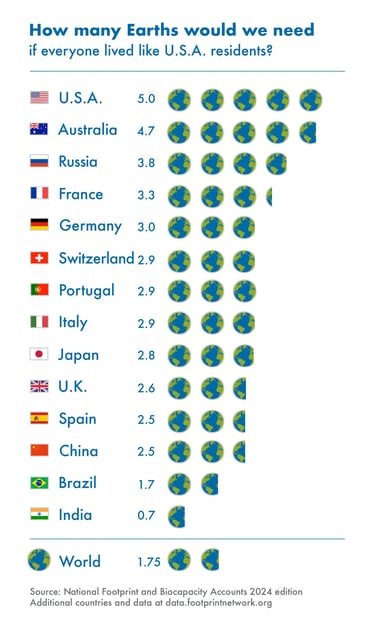
In a world defined by biophysical limits, competitive advantage belongs to those who understand that the economy is a subsystem of the biosphere. Green Cross UK aligns its intelligence framework with the Ecological Footprint methodology developed by Mathis Wackernagel — co-creator of the concept and a longstanding voice in the Green Cross International community — as one of its master indicators for ESG analysis.
Sustainability is a complex, multidimensional, and multidisciplinary system that defines the operational viability of every public or private organisation.
The global economy currently operates as a Ponzi structure. We are funding today’s growth by systematically liquidating the natural capital of the future.
Consuming Capital: We are not living on nature’s “interest” (regenerated resources), but devouring the capital itself—fertile soils, biodiversity, and carbon absorption capacity.
Invisible Ecological Debt: As in a financial pyramid, collapse occurs when demand exceeds the inflow of new resources.
Price Failure: Today’s markets suffer from severe myopia; prices do not reflect the true cost of ecological destruction, creating an asset bubble destined to burst.
The insolvency is not merely a matter of natural capital, but a systemic conflict between organic and non-organic rhythms. Whilst the biosphere and human beings operate under natural cycles of activity and rest, we have surrendered the pulse of our economy to algorithms and AI systems that neither sleep nor require repose. To subject a biological organism—or an ecosystem—to the relentless acceleration of non-organic agents is to force its inevitable collapse; it is a form of biological debt that nature can no longer afford to finance.
Ecological Footprint & ESG Metrics: Beyond Carbon
For Green Cross, the Ecological Footprint is one of the master indicator for ESG (Environmental, Social, and Governance) criteria. While many metrics focus solely on emissions, the Footprint measures total human demand on ecosystem services.
Solvency Proxy: The Ecological Footprint compares the demand of a company or country against available Biocapacity (nature’s supply).
Food & Energy Security: The current system is inefficient—for example, in Spain, it takes 8 calories of fossil fuel to produce just 1 calorie of bread.
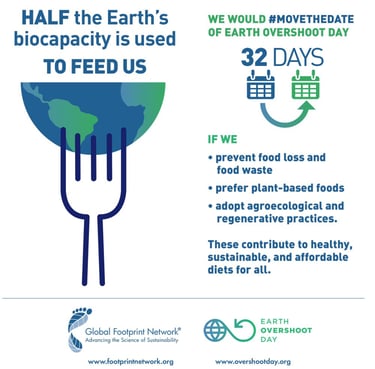
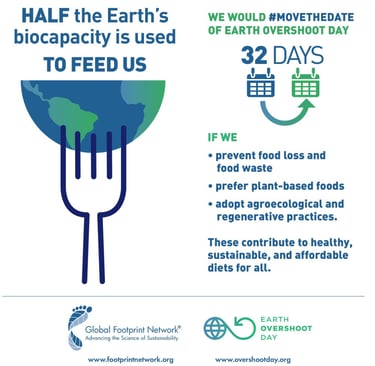
Integrated Risk Management: Currently, 50% of the planet’s biocapacity is used just to feed us. Ignoring this metric in sustainability reporting is like managing blindly in a context of growing scarcity.
Earth Overshoot: Defining Our Planetary Budget
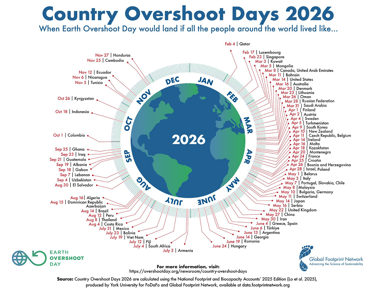
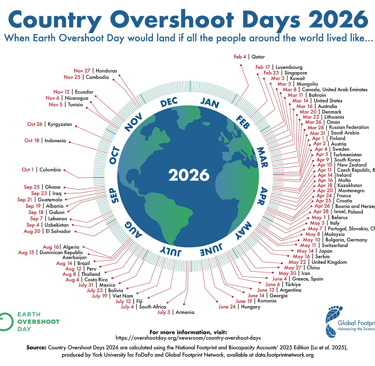
Earth Overshoot Day is the pivotal annual milestone that marks the date when humanity’s demand for ecological resources and services in a given year exceeds what the Earth can regenerate in that same year. It is not a metaphorical concept, but a science-based metric that quantifies our ecological balance sheet—or more accurately, our imbalance.
The Core Definition:
At its essence, Earth Overshoot measures the gap between human demand and planetary regeneration. Think of it as an audit of our collective bio-physical economy.
Demand is humanity's Ecological Footprint: the total area required to produce the renewable resources we consume (food, timber, fibres) and to absorb our waste, most notably carbon emissions from fossil fuels.
Regeneration is the planet's Biocapacity: the productive area—forests, grazing lands, cropland and fishing grounds—that can regenerate resources and absorb waste.
When our annual demand surpasses annual regeneration, we create an ecological deficit. We are essentially drawing down the planet's natural capital reserves, depleting stocks of resources and overfilling waste sinks like the atmosphere with CO₂. This deficit is the Overshoot.
Why This Metric Matters for Strategic Leadership:
For the C-Suite and policymakers, understanding Overshoot is critical because it reframes sustainability from a vague ambition into a material accounting issue. It reveals that key economic risks—supply chain instability, volatile commodity prices, climate disruption—are fundamentally rooted in this ecological deficit. It moves the conversation beyond mere carbon emissions to the broader systemic pressure our economies place on all natural systems.
Managing this deficit is the central challenge for long-term organisational and economic resilience. The #MoveTheDate mission provides the actionable framework for this management.
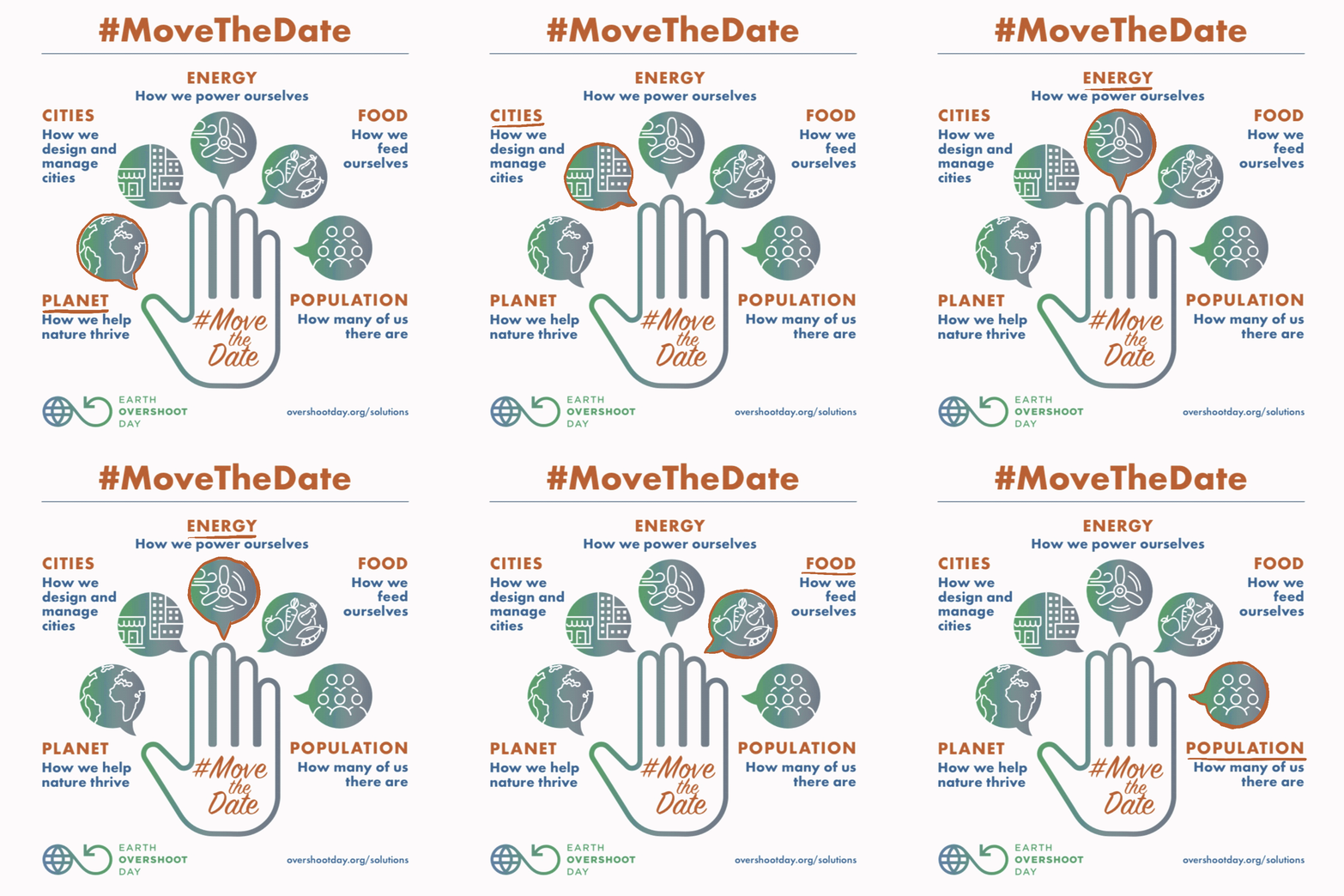
Moving the date of Earth Overshoot Day is the ultimate operational goal for a sustainable global economy. Green Cross UK aligns its strategy with the solutions pillars established by the Global Footprint Network, focusing on five key levers for systemic transformation:
PLANET (Helping Nature Thrive): Enhancing the planet's Biocapacity through large-scale ecosystem restoration, conservation, and regenerative practices that allow natural systems to rebound and produce more.
CITIES (How We Design Them): Transitioning to compact, resource-efficient urban models with regenerative infrastructure, reducing the ecological footprint per capita of our built environments.
ENERGY (How We Power Ourselves): Accelerating the shift to a 100% renewable energy matrix and pursuing radical energy efficiency to eliminate the carbon footprint, the largest single component of Overshoot.
FOOD (How We Feed Ourselves): Transforming agricultural systems towards regenerative practices, significantly reducing food waste, and shifting dietary patterns to lower the immense land and resource footprint of our food system.
POPULATION (How Many of Us There Are & Our Consumption Patterns): Addressing the scale of demand through empowerment, education, and the development of new models of prosperity that deliver wellbeing within planetary boundaries.
This integrated framework offers a clear roadmap for organisations seeking to transition from being part of the deficit problem to becoming architects of regeneration.
#MoveTheDate: The Strategic Framework for Systemic Change
Standing on the Shoulders of Giants
What it is
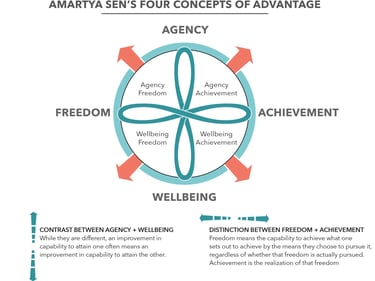
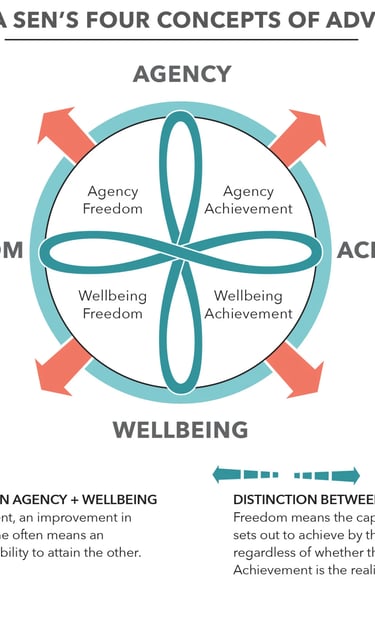
Amartya Sen — Nobel Prize in Economics 1998 — gave us a fundamentally different way of measuring human progress. Rather than income or consumption, Sen proposed that the quality of a human life must be assessed across four interconnected dimensions, organised into two contrasting pairs.
The first pair distinguishes between wellbeing — how one's own life is actually going — and agency — the capacity to act beyond one's own self-interest and change the world. The second pair distinguishes between achievement — what is actually attained — and freedom — what one is realistically in a position to attain.
Crossing these pairs reveals four realities that conventional economics ignores entirely:
Freedom of wellbeing — having the real option to live well.
Wellbeing achievement — actually living well.
Freedom of agency — having the real capacity to influence the world.
Agency achievement — actually producing change.
Two critical insights complete the framework. First, agency and wellbeing tend to grow together. Second, freedom and achievement are not the same thing. For Sen, freedom is valuable even when it is not exercised — because dignity requires the option, not just the outcome.
At its core, Sen tells us that if we only measure what people own or consume, we cannot know whether they are truly living a life of dignity.
Why we study it
Sen gives us the philosophical foundation for everything Green Cross UK places at the centre of its work. Human Dignity and Integral Human Development are not slogans — they are measurable dimensions of freedom.
His framework prevents us from accepting GDP growth as evidence of progress and forces the essential question: growth for whom, enabling what, and at what cost to whom? Without Sen, sustainability risks becoming a conversation about planetary systems that forgets the people inside them.
The differential it creates
Most sustainability frameworks start with the planet; Sen starts with the person. By grounding our work in capabilities rather than income metrics, Green Cross UK can assess whether a project genuinely expands human freedom — or merely generates a number that looks like progress.
This matters in practice: a renewable energy project that reduces carbon but violates Sen is not a success. The Capabilities Approach gives us the precision to see the difference — and the integrity to act.
The Capabilities Approach
No organization solves a systemic crisis alone. Green Cross UK draws its intelligence from the most rigorous and widely respected scientific, economic and philosophical frameworks available.
We do not simply cite these sources — we study them, apply them, and collaborate within the ecosystems they have created. Below are the eight frameworks that most directly inform how we understand the world and act within it.
IPCC — Intergovernmental Panel on Climate Change
What it is
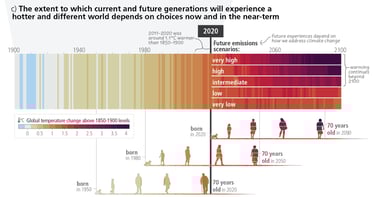
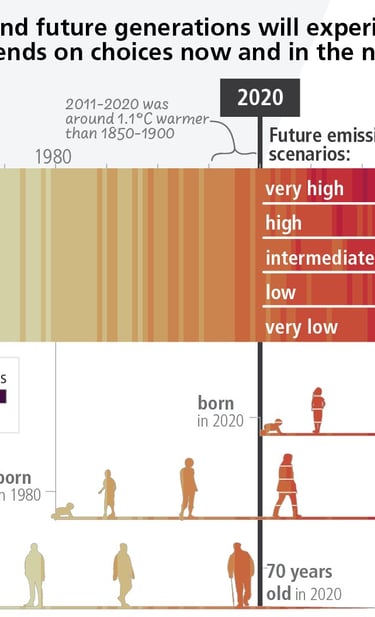
The IPCC prepares comprehensive Assessment Reports about the state of scientific, technical and socio-economic knowledge on climate change, its impacts and future risks. Thousands of scientists volunteer to review the publications in what is described as the biggest peer review process in the scientific community. With 195 member governments, the IPCC is the undisputed global authority on climate science.å
Why we study it
Every claim we make about mitigation pathways, every carbon reduction target we support, and every risk assessment we provide must be grounded in IPCC science. It is the standard against which credibility is measured, and the foundation upon which our MRV protocols are built.
The differential it creates
In a landscape where climate claims are made freely and verified rarely, anchoring our work explicitly to IPCC findings provides our partners with defensible, internationally recognised scientific authority. When we say a project is aligned with a 1.5°C pathway, we mean it precisely — and we can prove it.
Doughnut Economics
What it is
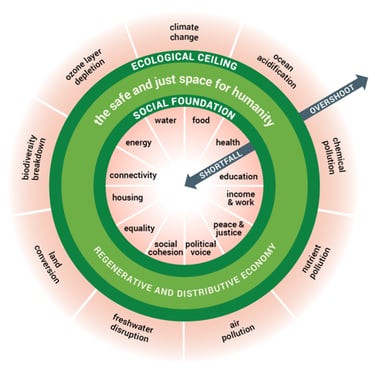
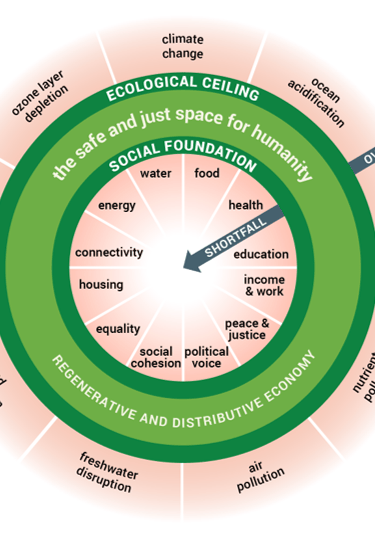
The Doughnut offers a vision of what it means for humanity to thrive in the 21st century. It consists of two concentric rings: a social foundation, to ensure no one is left falling short on life's essentials, and an ecological ceiling, to ensure humanity does not destabilise the life-supporting systems of Earth. Between these lies a space that is both ecologically safe and socially just.
Doughnut Economics calls for turning today's degenerative economies into regenerative ones, and divisive economies into distributive ones.
Why we study it
The Doughnut is the architecture of Green Cross UK's own model. It provides the visual logic to explain to any partner — city, corporation or government — why optimising for profit alone is structurally insufficient, and what a genuinely successful economy looks like.
The differential it creates
The Doughnut gives Green Cross UK a double mandate: no action we support can improve one dimension by worsening the other. Growth that breaches planetary limits is not progress; deprivation that falls below the social floor is not sustainability. This is not a compromise — it is a higher standard.

Planetary Boundaries - Stockholm Resilience Centre
What it is
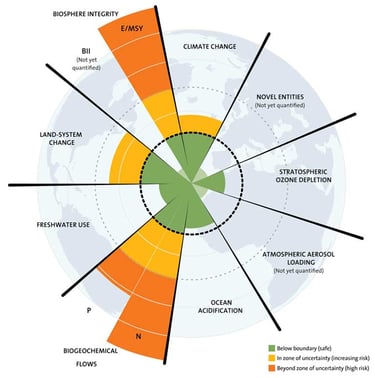
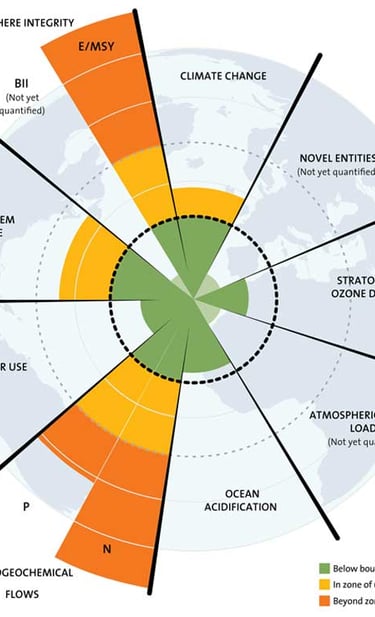
The planetary boundaries framework highlights the rising risks from human pressure on nine critical global processes that regulate the stability and resilience of the Earth. Developed by Johan Rockström and 28 leading scientists, it defines the safe operating space for humanity across nine interconnected systems.
The Planetary Health Check 2025 shows that seven of nine planetary boundaries have now been exceeded — for the first time including the boundary for ocean acidification.
Why we study it
This is the ecological ceiling of the Doughnut made quantifiable and updated annually. When we tell partners they are operating in overshoot, this is the scientific framework that proves it — with specific boundaries, specific thresholds, and specific data.
The differential it creates
Most ESG reporting focuses on carbon. Planetary Boundaries gives us eight additional dimensions of ecological risk that conventional sustainability metrics ignore entirely. Green Cross UK uses this framework to show partners the full spectrum of their ecological exposure — not just their emissions, but their contribution to biodiversity loss, freshwater depletion, and land system change.
Ellen MacArthur Foundation — Circular Economy
What it is
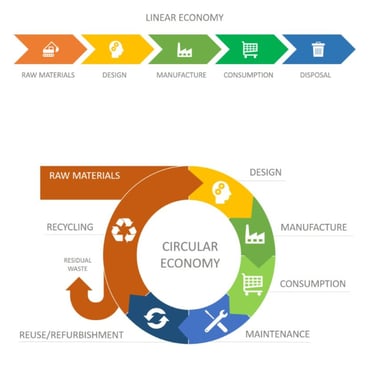
The linear, take-make-waste economy is the primary driver behind today’s crises of climate change, biodiversity loss, and pollution. A circular economy, designed to thrive within planetary boundaries, eliminates waste and pollution, circulates products and materials at their highest value, and regenerates nature. It delivers superior outcomes for people and the environment while driving economic resilience and opportunity. The Ellen MacArthur Foundation works globally to mobilise systems solutions at scale, uniting over 1,000 organisations behind these goals.
Why we study it
Circular Economy sits at the heart of our operational model. The Foundation has successfully translated regenerative principles into business language, models, and cases — transforming the transition from a purely ethical argument into a compelling economic imperative.
The differential it creates
When Green Cross UK engages C-Suite leaders, we do not ask them to sacrifice profit for the planet. We demonstrate, using a robust evidence base, that the circular economy is the next competitive advantage — reducing material costs, eliminating waste liabilities, and building the resilient supply chains that linear models cannot sustain.



WHERE TO FIND US:
Business Address: PO Box 12155, LONDON, WC1V 6DP, United Kingdom
Switchboard: +44 (0) 330 818 7382
Email: joinus@green-cross.org.uk


Endorsement of:

Disclaimer: The content on this website is for informational purposes only and does not constitute professional advice. For specific guidance, please contact us., and see Terms of Use.
Member of Green Cross International | Founded by Mikhail Gorbachev in 1993
Pro-cooperation · Pro-collaboration · Non-rivalry
© 2026 Green Cross United Kingdom. All rights reserved.