

OUR MODEL
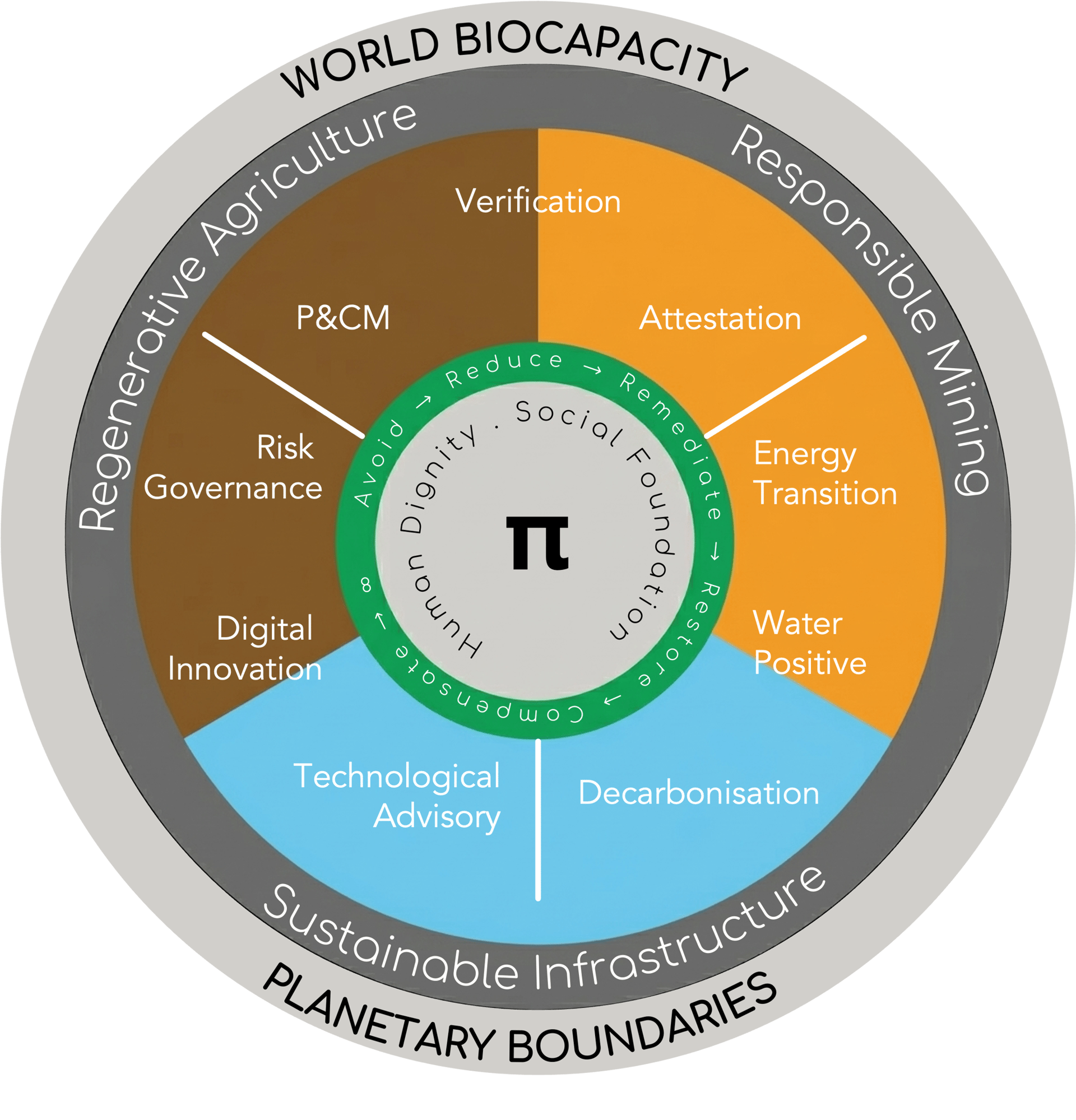
The Green Cross UK Doughnut
From First Principles to Verified Outcomes
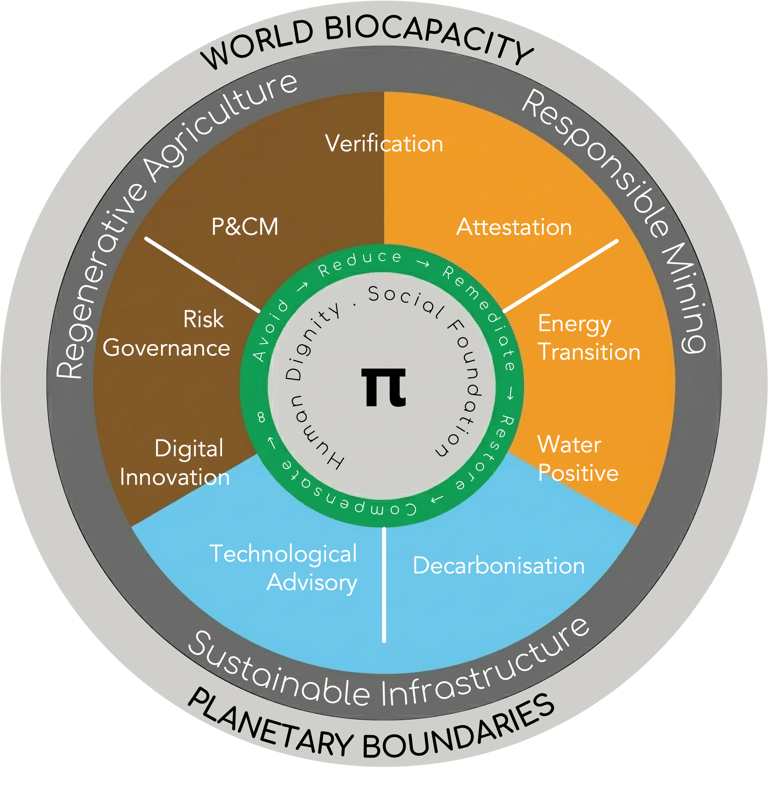
The Green Cross UK Doughnut is the operating framework that governs every mandate we execute. It is structured as a three-ring logic gate — each ring answering a different question: why we act, how we deliver, and where we deploy.
Read from the centre outward, it is also a sequence — one that does not skip steps.
01. The Centre: Non-Negotiable Foundations
Before any instrument is structured or any standard applied, we establish the ethical and physical boundaries of the mission.
Human Dignity & The Social Foundation: Every project operates within a social ecosystem. We hold the space for communities, workers, and future generations — through structural governance, stakeholder co-responsibility, and independent verification. Not as a gesture. As a design requirement.
Planetary Boundaries & World Biocapacity: The social foundation sits inside a finite ecological ceiling. World biocapacity — the planet's capacity to regenerate resources and absorb waste — is the absolute limit within which all economic activity must operate. This boundary determines whether a project is genuinely sustainable or merely less destructive.
The Mitigation Hierarchy: The sequence is fixed: Avoid → Reduce → Remediate → Restore → Compensate. It is applied before any instrument is structured, before any standard is selected. This is what transforms sustainability from a compliance cost into a driver of strategic value and operational resilience.
02. The Middle Ring: Integrated Capabilities
We configure bespoke delivery teams by synthesising three competencies and three capabilities, precisely matched to each mandate.
Competencies: Technological Advising · Risk Governance · Digital Innovation
Capabilities: Project & Change Management · Verification · Attestation
Each is a distinct discipline. Together, they form the operating system that translates planetary constraints into deliverable outcomes — from technical feasibility to social adoption, from data integrity to institutional arbitration.
None operates in isolation. None is optional. This integration is what converts complex boundary conditions into long-term competitive advantage.
03. The Outer Ring: Strategic Sector
We deploy where systemic friction is highest — at the intersection of decarbonisation, energy transition, and water positive. These are not separate agendas. They are the three pressures that determine whether a project creates durable value or accumulates future liability.
We operate through two delivery vehicles. Programmes drive systemic change against defined global challenges over the long term. Initiatives move faster — piloting methods and engaging communities. Against any given mandate, we draw from both.
The work is organised across three sectors:
Sustainable Infrastructure: Engineering systems built to outlast the political and financial cycles that fund them. Infrastructure is the physical layer where intent either becomes outcome — or doesn't.
Regenerative Agriculture: Restoring the natural capital that extraction has depleted. Decarbonisation and water positive are design requirements here — embedded in soil health, biodiversity, and food security as a single system.
Responsible Mining: Securing the green transition's supply chain without replicating its historical costs. This sector ensures that extraction does not become the next liability.
The Logic of Inseparable Solutions
Ecological integrity, social equity, and operational performance are not competing imperatives. In the Green Cross UK Doughnut, they are the same imperative — structured, sequenced, and delivered as one.
Because in the sectors where we operate, the organisations that treat them as separate are the ones that fail.


WHERE TO FIND US:
Business Address: PO Box 12155, LONDON, WC1V 6DP, United Kingdom
Switchboard: +44 (0) 330 818 7382
Email: joinus@green-cross.org.uk


Endorsement of:

Disclaimer: The content on this website is for informational purposes only and does not constitute professional advice. For specific guidance, please contact us., and see Terms of Use.
Member of Green Cross International | Founded by Mikhail Gorbachev in 1993
Pro-cooperation · Pro-collaboration · Non-rivalry
© 2026 Green Cross United Kingdom. All rights reserved.